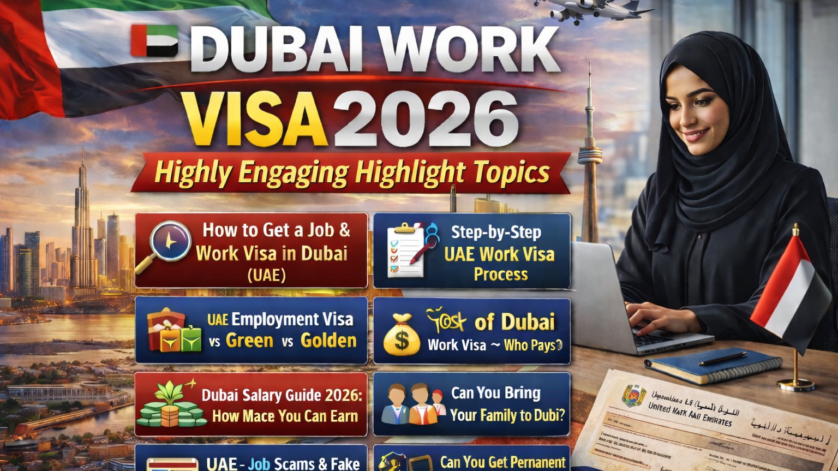
🇦🇪 Dubai Work Visa 2026 : Highly Engaging Highlight Topics
- ✨ Why Dubai Is the #1 Global Career Destination in 2026
- 💰 Tax-Free Salary Benefits: How Much You Really Earn
- 📌 UAE Work Visa Eligibility: Who Can Apply & Who Can’t
- 🏆 UAE Visa Types Explained: Employment, Green, Golden & Remote Work
- 🟢 Green Visa vs Standard Visa: Which Is Better for You?
- 🥇 Golden Visa Requirements: Long-Term Residency Opportunities
- ⚡ Step-by-Step UAE Work Visa Process (Start to Finish)
- 🏥 Mandatory Medical Test Rules & 2026 Health Updates
- 📄 Complete UAE Work Visa Documents Checklist
- 💵 Dubai Salary Guide 2026: Industry-Wise Income Breakdown
- 💸 Work Visa Cost Breakdown — Who Pays & What’s Free
- ⏳ UAE Work Visa Processing Timeline Explained
- 👨👩👧 Family Sponsorship Rules & Requirements
- 🌍 Remote Work Visa: Live in Dubai While Working Abroad
- 💼 Freelance Visa Opportunities for Independent Workers
- 🛑 UAE Job Scams & Fake Agent Warning Signs
- 🔎 How to Verify Genuine UAE Employers
- ⚖️ UAE Labour Rights Every Foreign Worker Should Know
- 🚀 Expert Tips to Get Your UAE Work Visa Approved Faster
- ⚠️ UAE Residency Reality: No Permanent Residency Path Explained
Dubai continues to attract hundreds of thousands of foreign professionals every year—and it’s not hard to understand why. Tax-free salaries, world-class infrastructure, a multicultural work environment, and a strategic location between East and West make the UAE one of the most compelling destinations for skilled workers anywhere in the world.
But before you book a flight or accept a job offer, understanding the UAE work visa process is essential. This guide covers everything you need to know about getting a Dubai work visa in 2026—from eligibility and employer sponsorship to medical tests, costs, and how to spot and avoid the fraudulent agents preying on job seekers.
Who Can Apply for a UAE Work Visa?
The good news is that the UAE work visa is open to foreign nationals from virtually every country. There are no nationality-specific restrictions for standard employment visas, though citizens of certain countries may face additional screening or documentation requirements.
Basic Eligibility Requirements
To qualify for a UAE work visa in 2026, you generally need to:
- Be at least 18 years of age
- Hold a valid passport with at least 6 months’ remaining validity
- Have a confirmed job offer from a UAE-licensed employer
- Possess the educational qualifications or professional experience relevant to your role
- Pass a medical fitness test upon arrival in the UAE
- Have a clean criminal record
Workers aged 65 and above may face higher government fees and additional health screening, though they are not automatically excluded from working in the UAE.
Who Is Not Eligible
Applicants may be deemed ineligible if they have a serious communicable disease identified during the medical fitness test, a serious criminal record, or previously overstayed a UAE visa. If you’ve been deported from the UAE or placed on an immigration blacklist, you’ll need to clear that record before applying.
Types of UAE Work Visas in 2026
The UAE offers several work visa categories depending on your professional profile, employment arrangement, and long-term goals.
Standard Employment Visa (Employer-Sponsored)
This is the most common route for foreign workers and the focus of most of this guide. Your UAE employer sponsors your visa, handles the application process, and is legally responsible for all associated government fees under Federal Decree-Law No. 33 of 2021.
Key features of the standard employment visa:
- Valid for 2 to 3 years (recently extended from 2 years to reduce the financial burden on workers)
- Tied to your sponsoring employer
- Requires a formal employment contract registered with the Ministry of Human Resources and Emiratisation (MOHRE)
- Can be renewed every 2–3 years as long as employment continues
Important: Under UAE labour law, your employer must pay 100% of all visa-related costs. If any employer asks you to pay your own visa fees, this is illegal and can be reported to MOHRE.
Green Visa (Self-Sponsored, 5 Years)
Introduced in 2022 and increasingly popular in 2026, the Green Visa allows skilled professionals, freelancers, and investors to sponsor themselves without needing an employer as guarantor.
Eligibility for the skilled employee Green Visa requires:
- Classification in occupational levels 1, 2, or 3 as per MOHRE
- A minimum monthly salary of AED 15,000 (approximately $4,080 USD)
- A bachelor’s degree or equivalent qualification
The Green Visa is ideal for professionals who want more independence from employer sponsorship, freelancers working with multiple clients, or those between jobs who wish to remain in the UAE legally.
Golden Visa (Long-Term Residency, 5–10 Years)
The UAE’s flagship long-term residency program is available to investors, top-tier professionals, entrepreneurs, scientists, and exceptional talents. In 2026, the UAE expanded the Golden Visa program to include nurses with 15+ years of UAE service, teachers with 10+ years of experience, content creators, and e-sports professionals.
Skilled professional qualifications for the Golden Visa include:
- A bachelor’s degree or higher
- Employment in a priority field (technology, medicine, engineering, business)
- A monthly salary of at least AED 30,000 ($8,165 USD) for the 5-year version, or AED 50,000+ for executives seeking the 10-year visa
Freelance Visa
For independent contractors working in sectors like media, technology, and education, the UAE offers a freelance permit (typically issued through a free zone authority) combined with residency. The freelance visa allows legal work for multiple clients without a single sponsoring employer. Costs are higher—a one-year freelance permit typically runs AED 20,000 ($5,445 USD)—but the flexibility it offers is significant.
Remote Work (Virtual Working) Visa
Updated in January 2026, the UAE’s Remote Work Visa allows foreign professionals to live in the UAE while continuing to work for an employer outside the country. Requirements include a minimum monthly income of $3,500 USD (from a foreign employer), valid health insurance, and proof of employment outside the UAE. The visa is valid for one year and is renewable.
The Employer Sponsorship Process: Step by Step
For most foreign workers, the standard employer-sponsored visa is the primary route. Here’s how the sponsorship process works in practice.
Step 1: Secure a Legitimate Job Offer
Everything begins with a genuine job offer from a UAE-licensed employer. Your employer must hold a valid business license in the UAE—either on the mainland (regulated by MOHRE) or in one of the UAE’s numerous free zones (regulated by respective free zone authorities).
Your employment contract must clearly state:
- Your job title and description
- Your monthly salary and benefits
- Working hours and leave entitlements
- Duration of the contract
All contracts should be registered with MOHRE (for mainland employers) or the relevant free zone authority. Never sign a contract that differs from what was verbally agreed—this is one of the most common ways workers get trapped in exploitative situations.
Step 2: Work Permit Approval from MOHRE
Once you accept the offer, your employer applies for your work permit through the MOHRE Tas’heel system or the relevant free zone portal. MOHRE reviews the application and either approves or requests corrections.
Work permit approval typically takes 2–5 working days for straightforward applications. Your employer downloads the approved work permit from the portal.
Step 3: Entry Permit Issuance
Following work permit approval, your employer or their PRO (Public Relations Officer) applies for an entry permit. This allows you to enter the UAE legally to complete the visa process.
The entry permit is valid for 60 days from the date of issue. You must enter the UAE and begin your medical test and residency process within this window. Failing to do so requires a new entry permit to be issued.
Step 4: Arrive in the UAE and Complete Medical Fitness Test
Upon arrival, you’ll complete your mandatory medical fitness test at a government-approved health center. This is covered in detail in the next section.
Step 5: Apply for Emirates ID
Within 15 days of arriving in the UAE, you must submit an Emirates ID application through the Federal Authority for Identity, Citizenship, Customs and Ports Security (ICP). The Emirates ID is your primary identification document in the UAE and contains all your residency and visa information.
Biometrics (fingerprints and photo) are collected at designated ICP centers. Processing takes approximately 5–7 working days after biometrics submission.
Step 6: Residence Visa Processing and Stamping
Following your medical clearance and Emirates ID application, your employer’s PRO submits your residence visa application. An important update from 2021 that remains in effect in 2026: UAE residence visas are no longer physically stamped in passports. Instead, all visa information is digitally linked to your Emirates ID.
Your residence visa is reflected on your Emirates ID card. Once you have your Emirates ID, your residency status is officially confirmed and you can begin working legally.
Step 7: Health Insurance Enrollment
Health insurance is mandatory for all expatriate employees in the UAE. In Dubai and Abu Dhabi, employers are legally required to provide health insurance for employees and their dependents. In Sharjah and the northern Emirates, employees may need to arrange their own coverage.
Without a valid health insurance card, MOHRE will not issue or renew your work visa.
Medical Test Requirements for UAE Work Visa in 2026
The medical fitness test is a mandatory step for all work and residence visa applicants. It is designed to screen for communicable diseases and ensure public health standards.
Where to Get Tested
You must attend a government-approved medical center. In Dubai, approved centers include Smart Salem locations and Dubai Health Authority (DHA)-approved facilities. In Abu Dhabi, Department of Health (DOH)-approved centers handle fitness tests. Reports from unapproved clinics are automatically rejected, wasting both your time and money.
Pro tip: Morning appointments (7:00–9:00 AM) consistently have shorter wait times. Avoid weekends and the first week of each month when volumes spike significantly.
What the Medical Test Includes
The standard UAE visa medical fitness test covers:
- Blood test: Screening for HIV, Hepatitis B, Hepatitis C, syphilis, and other communicable diseases
- Chest X-ray: Tuberculosis screening (pregnant applicants are normally exempt from this)
- General physical examination
2026 update: Category C professions (healthcare workers, educators, and domestic workers) now require mandatory Hepatitis B vaccination proof and titer reports as of January 2026. If you haven’t been vaccinated, you’ll need three doses before your visa can be processed—this can add several months to your timeline, so plan accordingly.
Processing Time and Results
- Standard processing: Results within 48–72 hours
- Express processing: Results within 24 hours (additional fee applies)
The medical fitness certificate is generally valid for approximately 3 months. If your overall visa process is delayed and the certificate expires, you may need to retest.
What Happens If You Fail
If a communicable disease is detected, the visa process is paused. In some cases, treatment in the UAE is possible before clearance is granted. In more serious cases, you may be deemed medically unfit and required to return to your home country. The UAE health authorities handle these situations on a case-by-case basis.
Required Documents Checklist
Having all documents ready before starting the process prevents costly delays. Here is what you’ll typically need:
Before entering UAE (for entry permit):
- Valid passport (minimum 6 months remaining validity)
- Passport-sized photograph with white background
- Signed employment contract
- Educational certificates (attested by your home country’s Ministry of Foreign Affairs AND the UAE Embassy in your country, then authenticated by UAE’s MOFA)
- Previous employment reference letters (for relevant experience verification)
- Police clearance certificate from your home country
After arriving in UAE (for residence visa):
- Entry permit (issued by employer)
- Medical fitness certificate from approved UAE health center
- Emirates ID application receipt
- Health insurance card
- Completed visa application form
For document attestation: All academic credentials and certain personal documents must be attested—first by your home country’s foreign ministry, then by the UAE Embassy in your country, and finally by the UAE Ministry of Foreign Affairs (MOFA). This attestation process costs approximately AED 750–2,000 ($205–545 USD) depending on your country of origin and is one of the most time-intensive steps. Start early.
Typical Salary by Sector in Dubai (2026)
One of Dubai’s most significant advantages is the absence of personal income tax, meaning your gross salary is your take-home pay. Here’s a realistic overview of current salary ranges by sector:
Technology and IT
- Software engineers: AED 12,000–35,000/month ($3,265–9,530 USD)
- Data scientists and AI specialists: AED 18,000–45,000/month ($4,900–12,250 USD)
- IT project managers: AED 20,000–50,000/month ($5,445–13,610 USD)
- Cybersecurity professionals: AED 18,000–40,000/month ($4,900–10,890 USD)
Healthcare
- Registered nurses: AED 6,000–14,000/month ($1,635–3,810 USD)
- Medical doctors (general): AED 18,000–40,000/month ($4,900–10,890 USD)
- Specialist physicians: AED 35,000–80,000/month ($9,530–21,775 USD)
- Physiotherapists: AED 8,000–18,000/month ($2,180–4,900 USD)
Finance and Banking
- Accountants (CPA/ACCA): AED 12,000–25,000/month ($3,265–6,805 USD)
- Financial analysts: AED 15,000–30,000/month ($4,085–8,165 USD)
- Investment bankers: AED 25,000–70,000/month ($6,805–19,050 USD)
Engineering and Construction
- Civil engineers: AED 10,000–25,000/month ($2,720–6,805 USD)
- Mechanical engineers: AED 10,000–22,000/month ($2,720–5,990 USD)
- Project managers: AED 18,000–40,000/month ($4,900–10,890 USD)
- Quantity surveyors: AED 12,000–28,000/month ($3,265–7,620 USD)
Hospitality and Tourism
- Hotel managers: AED 15,000–35,000/month ($4,085–9,530 USD)
- F&B managers: AED 10,000–22,000/month ($2,720–5,990 USD)
- Chefs (experienced): AED 6,000–18,000/month ($1,635–4,900 USD)
- Front desk and service staff: AED 3,500–7,000/month ($955–1,905 USD)
Education
- School teachers: AED 8,000–20,000/month ($2,180–5,445 USD)
- University lecturers: AED 15,000–35,000/month ($4,085–9,530 USD)
Salary note: Many UAE employers supplement base salary with housing allowance (typically 20–25% of salary), transportation allowance, annual flight tickets home, and health insurance. Always evaluate the total compensation package, not just the base salary.
Cost of living context: A single professional typically spends AED 6,000–12,000/month on living expenses in Dubai. A family of three needs approximately AED 15,000–25,000/month. Mid-level professionals earning AED 15,000–30,000 can maintain a comfortable lifestyle with meaningful savings potential.
Total Cost Breakdown (in USD)
Understanding the cost structure helps you evaluate job offers and ensures you know your legal rights.
Who Pays What
Under UAE Federal Decree-Law No. 33 of 2021, your employer is legally required to cover 100% of all work permit and visa-related costs. These costs cannot be deducted from your salary or recovered through bonds or hidden agreements. Any employer demanding upfront payment for visa processing is violating UAE law.
Employer-Paid Costs (Standard 2-Year Employment Visa)
| Item | Approximate Cost (USD) |
|---|---|
| MOHRE work permit fees | $200–$450 |
| Entry permit fee | $55 |
| Medical fitness test | $80–$135 |
| Residence visa issuance | $135–$270 |
| Emirates ID (2–3 years) | $100–$135 |
| Document typing / PRO services | $55–$135 |
| Health insurance (mandatory) | $545–$1,635/year |
| Total (excluding insurance) | $625–$1,180 |
| Total (including health insurance) | $1,170–$2,815 |
For free zone visa packages, costs are typically 30–40% lower, but work authorization is restricted to that specific free zone and related entities.
Fast-Track / Optional Costs
- Fast-track visa processing: $135–$270 (reduces timeline to 5–7 working days)
- Document attestation: $205–$545 (paid by employee for personal documents)
- GAMCA medical test (in home country, for certain nationalities): $55–$110
Your Personal Settlement Costs (Budget These Separately)
These are not visa fees, but common costs new arrivals face:
- First month rent + security deposit in Dubai: $2,725–$5,450
- Initial household setup: $1,090–$2,725
- Transportation before first paycheck: $135–$270
- Phone and SIM setup: $55–$110
- Modest emergency buffer recommended: $2,000–$3,000
Recommended total personal savings before arriving: $6,000–$12,000 to settle comfortably without financial stress.
Processing Timeline: What to Realistically Expect
| Stage | Timeframe |
|---|---|
| Job offer acceptance and contract signing | Day 1 |
| Work permit approval (MOHRE) | 2–5 working days |
| Entry permit issuance | 3–7 working days |
| Travel to UAE | Variable |
| Medical fitness test | 1 day (results in 48–72 hours) |
| Emirates ID biometrics and application | 1 day (card ready in 5–7 working days) |
| Residence visa processing | 5–10 working days |
| Total: Entry permit to legal work status | 3–5 weeks |
Standard processing with fast-track services: The entire process from entry permit to active Emirates ID can be completed in as little as 7–14 working days if your employer uses fast-track services (additional $135–270 USD).
Document attestation (before applying): Allow 4–12 weeks for attesting academic credentials through official channels in your home country. This is frequently the biggest bottleneck—start the attestation process the moment you begin seriously applying for UAE jobs.
How to Find Genuine UAE Employers
Finding a legitimate employer is your most critical protection against fraud and exploitation.
Trusted Job Search Platforms
Official and highly reliable:
- Bayt.com — The largest job portal in the Arab world; well-established with verified employers
- Naukrigulf.com — Widely used for professional roles across the Gulf
- LinkedIn UAE — Most multinational and corporate employers post here; allows direct employer verification
- Indeed UAE — Large volume of listings with company reviews
Sector-specific platforms:
- Healthcare: Doctors.ae, Health Recruiters International
- Hospitality: CatererGlobal, Hosco
- Finance: eFinancialCareers
- Construction and engineering: GulfTalent, CareerJet UAE
- Education: TES (Times Educational Supplement), Teach Away
Company career portals: For larger organizations—Emirates, Etisalat (e&), DP World, ADNOC, Emaar, DEWA, Aldar—apply directly through their official websites. These companies hire internationally at scale and have structured immigration processes.
Verifying Employer Legitimacy
Before accepting any offer, take time to verify:
- Trade License: Ask for the company’s UAE trade license number and verify it at the Dubai Department of Economy and Tourism (DED) portal or the relevant emirate’s business registry
- MOHRE registration: Verify the employer is registered on the MOHRE Tas’heel portal
- LinkedIn presence: A legitimate company has an established LinkedIn page with real employees, history, and activity
- Physical address: Confirm the company has a verifiable physical address, not just a PO box
- Interview process: Legitimate employers conduct video or in-person interviews and request professional documentation—they don’t offer jobs without a thorough process
Red flag: If you receive a job offer without applying, or after only a brief WhatsApp message exchange, verify the employer with extra care.
How to Avoid Fake Agents and Scams
The UAE job market attracts a disproportionate number of scammers who exploit the dreams of hopeful applicants. Here are the most common frauds targeting foreign job seekers in 2026, and exactly how to protect yourself.
The Advance Fee Scam
How it works: A “recruiter” or “agent” contacts you with a highly attractive job offer in Dubai—often with an unusually high salary and benefits. After initial enthusiasm, they inform you that you must pay an “arrangement fee,” “visa processing fee,” or “security deposit” ranging from $200 to $2,000 to proceed.
The reality: Legitimate UAE employers and licensed recruitment agencies never charge candidates any fees. Under UAE law, all visa costs are borne by the employer. If you’re asked to pay anything upfront, walk away immediately.
Fake Job Offer Letters
How it works: Scammers email professional-looking UAE job offer letters using copied logos and formatting from genuine companies like Emirates, ADNOC, or major Dubai hotels. The letter requests fees for “processing,” “document clearance,” or “accommodation booking.”
How to protect yourself:
- Never accept a job offer by email alone without going through the company’s official recruitment process
- Call the company’s official HR department directly using a number found on their official website (not one provided in the suspicious email)
- Search the hiring manager’s name on LinkedIn to verify they actually work for the company
The Fake Visa Guarantee
How it works: An “immigration agent” promises to secure you a UAE work visa for a fee, claiming they have “connections” inside the immigration authority or that they can obtain a visa without a job offer.
The reality: No legitimate agent can guarantee visa approval or obtain a work visa without a genuine employer sponsorship. UAE work visas are strictly tied to employer sponsorship. There are no shortcuts, and anyone claiming otherwise is lying.
Bait-and-Switch Employment Contracts
How it works: You’re offered one contract before arriving in the UAE, but upon arrival the employer presents a different contract with lower salary, fewer benefits, or different job responsibilities. Hoping you won’t walk away after traveling, some employers count on compliance.
How to protect yourself:
- Never travel to UAE without a fully signed, MOHRE-verified employment contract
- Compare the contract you sign before traveling with any document presented upon arrival
- Know that under UAE law, you have the right to refuse a different contract—report any pressure tactics to MOHRE immediately
How to Verify Agents and Recruiters
Legitimate recruitment agencies operating in the UAE must be licensed by MOHRE. You can verify any agency’s license on the MOHRE portal at mohre.gov.ae. Licensed agencies are also listed on the official UAE government portal at u.ae.
If in doubt, contact MOHRE directly through their official call center (800 60) or use the official MOHRE app to verify employer and agency credentials.
Expert Success Tips for Your UAE Work Visa Application
Tip 1: Get Document Attestation Done Early
Attestation is consistently the most time-consuming part of the process and the one most applicants underestimate. Start the chain—home country foreign ministry → UAE Embassy → UAE MOFA—at least 6–8 weeks before your target start date.
Tip 2: Know Your Occupational Classification
MOHRE classifies workers into three skill levels (Category 1: degree holders; Category 2: diploma holders; Category 3: others). Your classification affects visa fees your employer pays, and some employers may be more or less equipped to sponsor certain categories. Understanding where you fit helps you target appropriate employers.
Tip 3: Mainland vs. Free Zone: Know the Difference
A free zone visa is cheaper and faster to obtain, but it restricts you to working within that specific free zone. If you accept a free zone job offer but expect to work for multiple clients or may switch employers, a mainland visa offers significantly more flexibility. This distinction is worth discussing with your prospective employer before signing.
Tip 4: Verify Your Employer’s MOHRE Category
MOHRE classifies employers into Category 1, 2, and 3 based on compliance record and workforce composition. Category 1 employers process visas faster and at lower cost. Asking a prospective employer about their MOHRE classification is a reasonable professional question that also signals your seriousness.
Tip 5: Healthcare Workers—Plan for Vaccination Requirements
If you’re applying for Category C roles (healthcare, education, domestic work), start your Hepatitis B vaccination series immediately if you haven’t been vaccinated. The three-dose schedule spans 6 months. Failing to plan for this requirement is the single most common source of unexpected delays for healthcare workers in 2026.
Tip 6: Consider the Green Visa for Long-Term Flexibility
If you qualify—particularly if you’re a skilled professional earning AED 15,000/month or more—the Green Visa’s self-sponsorship model is worth the additional setup cost compared to an employer-tied visa. It gives you the freedom to change jobs without visa complications, take consulting assignments, and maintain residency during employment transitions.
Tip 7: Understand Your Rights Under UAE Labour Law
UAE labour law has strengthened considerably in recent years. Key protections for foreign workers include:
- Employer must pay all visa and work permit costs
- Wages Protection System (WPS) ensures salaries are paid electronically and on time
- Workers can file complaints with MOHRE if rights are violated
- Employees can transfer to a new employer with a No Objection Certificate (NOC) from their current employer
Knowing your rights is not optional knowledge—it’s essential protection.
Tip 8: Keep Copies of Everything
Maintain digital and physical copies of your employment contract, entry permit, medical test results, Emirates ID, and all correspondence with your employer and immigration authorities. Store copies in a cloud service accessible from anywhere.
Frequently Asked Questions
1. Do I need a job offer before applying for a UAE work visa?
For a standard employer-sponsored work visa—the most common type—yes, a confirmed job offer from a UAE-licensed employer is required. The employer initiates the entire process and legally sponsors your visa.
However, there are alternatives if you don’t yet have an offer. The Green Visa allows skilled professionals meeting salary and qualification thresholds to self-sponsor for 5 years. The Remote Work Visa lets you live in the UAE while working for a foreign employer. You can also enter on a tourist visa while job hunting, though working on a tourist visa is illegal and carries serious penalties including fines and deportation.
2. How long does it take to get a UAE work visa in 2026?
From entry permit to legally working with your Emirates ID, the realistic timeline is 3–5 weeks for most standard applications. The breakdown is roughly: entry permit (3–7 working days), medical test and results (2–4 days), Emirates ID processing (5–7 working days), and residence visa issuance (5–10 working days).
However, document attestation—which must be completed in your home country before the process begins—can add 4–12 weeks if you haven’t started early. Fast-track services can compress the UAE processing steps to 7–14 working days for an additional fee of $135–270 USD. Plan for a total timeline of 6–14 weeks from job offer acceptance to arrival and legal work status.
3. How much does a UAE work visa cost in 2026?
For a standard 2-year mainland employment visa, total government fees and mandatory services (medical test, Emirates ID, and health insurance) typically run between $625–$2,815 USD. Critically, your employer is legally required to pay all of these costs. Under Federal Decree-Law No. 33 of 2021, employers cannot deduct visa fees from your salary or demand reimbursement through any mechanism.
The only costs you should personally plan for are document attestation fees for your own certificates ($205–$545 USD) and your personal settlement expenses upon arrival in Dubai ($6,000–$12,000 recommended as a buffer).
4. Can my family join me in Dubai on a work visa?
Yes. Once you have your UAE residency visa and Emirates ID, and provided your salary meets the minimum threshold, you can sponsor your spouse and children for dependent residency visas.
Minimum salary requirements for family sponsorship:
- Spouse and children: AED 4,000/month ($1,090 USD) minimum, though many landlords require proof of higher income for tenancy
- Sponsoring parents: AED 20,000/month ($5,445 USD) minimum
Your dependents will each need a medical fitness test, Emirates ID, and health insurance. Sponsoring each family member adds approximately $500–$900 USD in government fees. The overall process for dependents takes 3–4 weeks after your own residency is established.
5. What happens if I want to change employers while in Dubai?
Changing employers in the UAE is permitted but involves a formal process. You’ll typically need a No Objection Certificate (NOC) from your current employer, or you can transfer to a new employer after completing 6 months of service in certain circumstances even without an NOC.
Your new employer sponsors a new work permit and residence visa. Your current visa must be cancelled before or during this transfer process—your new employer’s PRO typically coordinates this. If your employment is terminated, you receive a grace period (typically 30 days for most workers) to find a new sponsor before you’re required to leave the UAE.
The Green Visa eliminates this complication entirely by removing employer sponsorship from the equation—one of its primary advantages for mid-career professionals.
6. Is there any language requirement for a UAE work visa?
There is no formal government-mandated language test requirement for most UAE work visas. However, many employers in professional roles expect strong English proficiency, and some positions—particularly in education, healthcare, and client-facing roles—may require language certifications (IELTS, TOEFL, or OET for healthcare workers).
Arabic language skills are not required for most expatriate roles but are a significant advantage for managerial positions and roles that involve engagement with UAE government entities or local clients.
7. Can I apply for permanent residency or citizenship after working in the UAE?
This is a common misconception worth addressing directly. The UAE does not offer a traditional permanent residency or naturalization pathway for most foreign workers, regardless of how long you’ve lived and worked there.
The closest equivalent is the Golden Visa (5–10 years), which provides long-term renewable residency to qualifying investors, skilled professionals, and exceptional talents. However, it must be renewed and does not confer citizenship rights.
UAE citizenship is extremely rarely granted to non-nationals and is generally limited to exceptional cases of extraordinary contribution. This is a fundamental difference from countries like Canada or Germany, and it’s important to enter the UAE work experience with this understanding clearly in mind.
Final Thoughts: Is Dubai the Right Move for You?
Working in Dubai in 2026 offers a genuinely compelling proposition—particularly for professionals in technology, healthcare, finance, and engineering. Tax-free salaries, rapid career advancement opportunities, international networking, and a quality of life that blends modern luxury with multicultural vibrancy are real and tangible advantages.
That said, a successful Dubai career move requires clear-eyed preparation:
- Verify everything: Employer legitimacy, contract terms, and agent credentials
- Know your rights: UAE labour law is on your side, but only if you use it
- Plan financially: Budget not just for visa fees, but for the full cost of establishing yourself in one of the world’s more expensive cities
- Think long-term: If permanent residency or eventual citizenship is your goal, Dubai is a stepping stone—not an endpoint in the same way Canada or Europe might be
For skilled professionals approaching the process with proper preparation and realistic expectations, a Dubai work visa in 2026 is very achievable. The process is structured, the timeline is predictable, and the opportunities on the other side are real.
Official resources for your application:
- UAE Government Portal: u.ae
- MOHRE (work permits): mohre.gov.ae
- GDRFA Dubai (residence visas): gdrfad.gov.ae
- ICP (Emirates ID): icp.gov.ae
- MOHRE Call Center: 800 60
Verify all fee information directly with official UAE government sources before submitting your application, as fees are subject to periodic revision.