
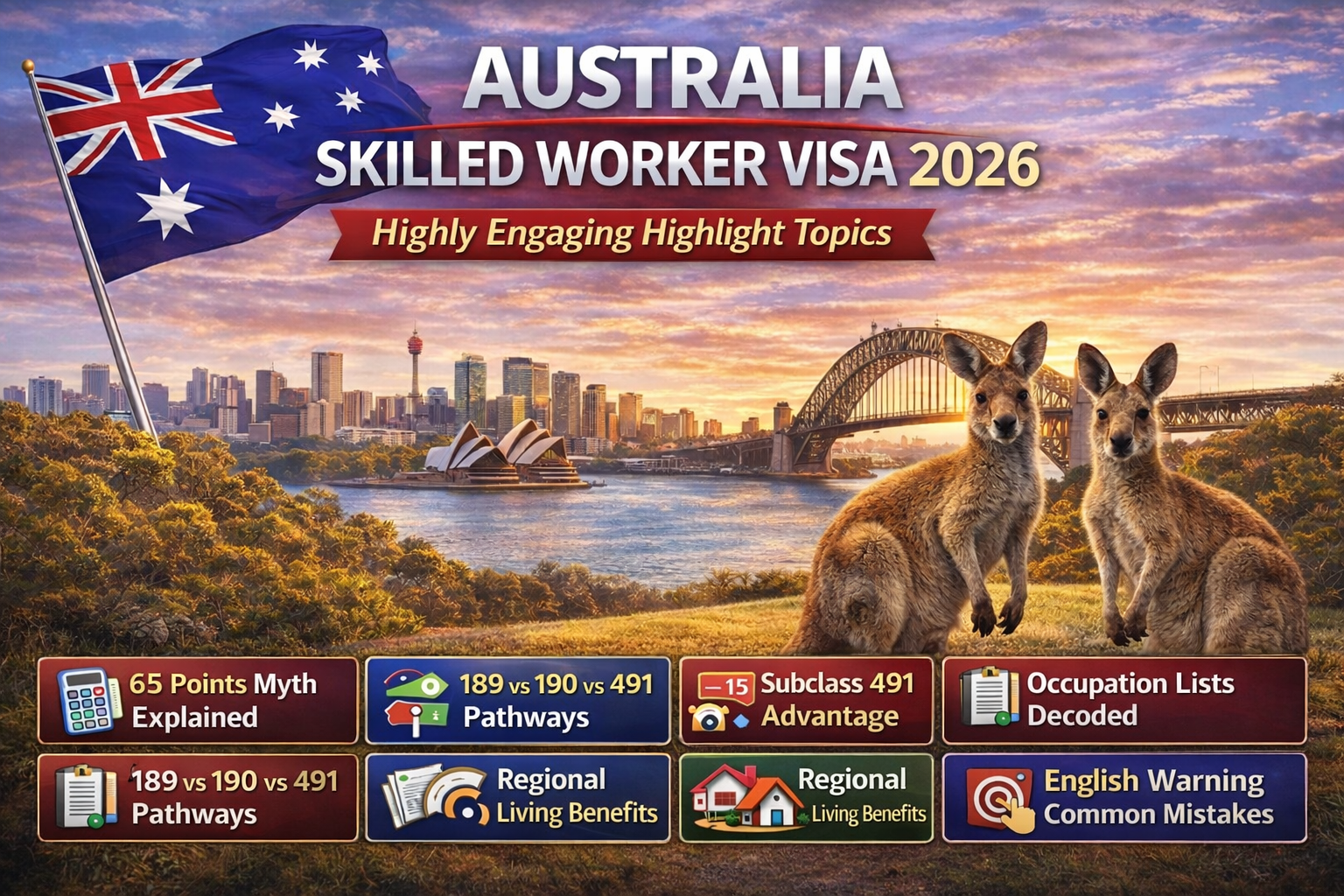
🇦🇺 Australia Skilled Worker Visa 2026 – Key Highlights You Must Know
🧮 65 points myth explained: Minimum eligibility vs real competitive score
🧭 Choose your pathway: 189 vs 190 vs 491 — which visa fits your score?
⚔️ Independent vs State vs Regional: Clear side-by-side comparison
🏆 Subclass 189 (Independent PR): The most desired visa — and the hardest to get
🎯 Subclass 190 strategy: How state nomination +5 points changes your chances
🚀 Subclass 491 advantage: The realistic pathway under 80 points (+15 points boost)
📊 Invitation score trends: Real 2025-2026 cutoff scores by occupation
🎂 Age deadline warning: Must be under 45 at invitation — not at application
🗣️ English score power: IELTS/PTE upgrades can add up to 20 points
💼 Skills assessment authorities: ACS, Engineers Australia, VETASSESS, AHPRA — who checks your occupation
📋 Occupation lists decoded: MLTSSL vs STSOL vs ROL and why they matter
⏳ Timeline explained: From EOI to visa grant (realistic 18 months – 3+ years)
🏦 Total cost breakdown 2026: Real PR budget from AUD $7,000 – $14,000+
📈 Salary expectations: IT, Engineering, Healthcare earning ranges in Australia
👨👩👧 Partner benefits: How spouse skills or English adds 5–10 points
🏡 Regional living benefits: Lower cost of living + faster PR pathway
🚫 Common mistakes: Over-claiming points, expired tests, wrong experience counting
🎯 Smart strategy: Why waiting for 189 alone can delay migration for years
🏁 PR & citizenship timeline: 189/190 immediate PR vs 491 → PR after 3 years
Australia’s skilled migration program is one of the most structured, data-driven, and genuinely competitive immigration systems in the world. Unlike some countries where visa outcomes feel opaque or arbitrary, Australia’s General Skilled Migration (GSM) program operates on a transparent points-based framework — one where every decision is quantifiable and your position in the queue is calculable before you even apply.
That transparency, however, can also be deceptive. A 65-point minimum score sounds achievable. The reality — where competitive rounds in 2025 regularly required 85+ points just to receive an invitation — tells a different story. The minimum score required remains 65 points, but competitive invitation rounds favour applicants with 80–85+ points, depending on occupation and visa subclass.
This guide is written for serious applicants: those who want to understand not just the rules, but the strategy behind maximising their chances in 2026.
The Three Pillars of Australian Skilled Migration: Subclass 189, 190, and 491
Australia’s General Skilled Migration program operates through three primary visa subclasses, each designed for a different profile and offering a distinct path to permanent residence. Understanding the fundamental differences between them is your first strategic decision.
Subclass 189 — Skilled Independent Visa (Permanent Residence)
The Subclass 189 is Australia’s flagship points-tested visa and arguably the most desirable pathway for skilled migrants seeking complete independence. It grants immediate permanent residence to the primary applicant and their family, with no sponsorship obligations and no requirement to live or work in a specific region of Australia.
Key characteristics:
- Permanent residence from the date of grant
- No employer sponsorship required
- No state or territory nomination required
- Complete freedom to live, work, and study anywhere in Australia
- Pathway to Australian citizenship after meeting residency requirements
The competitive reality: Because of its independence and permanence, the Subclass 189 is the most competitive visa under the GSM program. High-demand occupations like IT, engineering, and accounting often need 85–95 points for Subclass 189. If your score sits between 65 and 80, the 189 is theoretically available to you but practically inaccessible for most occupations. The 190 or 491 will be more realistic.
Occupation requirement: Your nominated occupation must appear on the Medium and Long-term Strategic Skills List (MLTSSL) — Australia’s most selective occupation list, reserved for roles deemed critical to the national economy over the long term.
Subclass 190 — Skilled Nominated Visa (Permanent Residence)
The Subclass 190 requires nomination by an Australian state or territory government, but in exchange offers permanent residence upon grant — just like the 189. The nomination itself contributes 5 additional points to your SkillSelect score, which can be the difference between sitting in the pool indefinitely and receiving an invitation.
Key characteristics:
- Permanent residence from grant date
- Requires nomination from an Australian state or territory
- 5-point bonus added to SkillSelect score upon nomination
- Obligation to live and work in the nominating state for at least 2 years (legally enforceable)
- Can nominate from either the MLTSSL or the Short-term Skilled Occupation List (STSOL)
Strategic advantage: The 190 is particularly powerful for applicants sitting at 75–80 points who cannot reach the 189 threshold. Adding 5 state nomination points brings them into competitive range. Each state and territory sets its own occupation lists and requirements, and these change quarterly — monitoring state nomination updates is a critical ongoing task for 190 applicants.
State nomination competition: Some states receive thousands of Expressions of Interest for a handful of nomination places. Western Australia, South Australia, and Tasmania have historically offered more accessible nomination criteria, particularly for trade and healthcare occupations. Victoria and New South Wales attract the highest volume of applications, making their nomination rounds significantly more competitive.
Subclass 491 — Skilled Work Regional (Provisional) Visa
The Subclass 491 is Australia’s regional migration visa — a provisional (temporary) 5-year pathway designed to attract skilled workers to regional Australia. It grants 15 additional points to your SkillSelect score rather than the 190’s 5 points, making it the most accessible route for applicants with lower base scores.
Key characteristics:
- Provisional visa valid for 5 years (not immediate permanent residence)
- Requires state/territory nomination OR sponsorship by an eligible family member living in regional Australia
- 15-point bonus added to SkillSelect score
- Must live and work in a designated regional area of Australia throughout the 5-year validity
- Eligible to apply for permanent residence (Subclass 191) after 3 years of living and working in a regional area
The regional trade-off: The 491 is accessible to more applicants precisely because it requires regional living. For many applicants, this is genuinely attractive — regional Australia offers lower cost of living, strong community integration, and often faster career advancement than the hyper-competitive major city markets. For others, the requirement to forgo Sydney or Melbourne is a significant constraint.
Designated regional areas include: All of Australia except Sydney, Melbourne, Brisbane, Gold Coast, and Perth metropolitan areas. Many highly liveable cities qualify as regional — Canberra, Adelaide, Hobart, Darwin, Newcastle, Wollongong, Geelong, and the Gold Coast hinterland among them.
Subclass Comparison: At a Glance
| Factor | 189 (Skilled Independent) | 190 (Skilled Nominated) | 491 (Regional Provisional) |
|---|---|---|---|
| Visa type | Permanent | Permanent | Provisional (5 years) |
| Sponsorship required | None | State/Territory government | State/Territory OR eligible family member |
| Points bonus | None | +5 points | +15 points |
| Occupation lists | MLTSSL only | MLTSSL + STSOL | MLTSSL + STSOL + ROL |
| Live anywhere in Australia | Yes — complete freedom | No — must live in nominating state (2 years) | No — must live in regional area (5 years) |
| Work rights | Unrestricted | Unrestricted | Unrestricted (in regional area) |
| Spouse work rights | Yes | Yes | Yes |
| Path to PR | Immediate | Immediate | After 3 years via Subclass 191 |
| Competitive entry score (2025–26) | 85–95+ points | 75–85+ points | 65–80 points |
| Best for | High-scorers, independent professionals | Mid-scorers with in-demand state occupations | Applicants below 80 points; regional lifestyle acceptable |
The Points Test Explained: How Australia Scores You
The Australian points test allocates points across seven categories. Your total score determines where you rank in the SkillSelect pool for your nominated occupation. Here is a complete, accurate breakdown of every point available in 2026.
1. Age (Maximum: 30 Points)
Applicants aged 25–33 years receive maximum age points (30 points), making this the optimal age bracket for PR applications.
| Age at time of invitation | Points |
|---|---|
| 18 – 24 years | 25 points |
| 25 – 32 years | 30 points |
| 33 – 39 years | 25 points |
| 40 – 44 years | 15 points |
| 45 years and above | 0 points |
Strategic note: Age is your only truly non-improvable factor. If you are approaching a threshold birthday, the timing of your EOI submission can legitimately affect your score by up to 15 points. A person who turns 33 loses 5 points; someone turning 40 loses 10 points. If you are close to a threshold, calculate your timeline accordingly.
2. English Language Ability (Maximum: 20 Points)
| English Level | Points |
|---|---|
| Competent English (IELTS 6.0 each band, or equivalent) | 0 points |
| Proficient English (IELTS 7.0 each band, or equivalent) | 10 points |
| Superior English (IELTS 8.0 each band, or equivalent) | 20 points |
Important 2025 update: For tests taken on or after 7 August 2025, new language test scoring rules apply to the points calculation. If your current English test was taken before this date and you intend to include it in a new application, verify that it still meets the updated requirements with the Department of Home Affairs or a registered migration agent.
Accepted tests: IELTS Academic or General Training, PTE Academic, Cambridge C1 Advanced (CAE), TOEFL iBT, OET (healthcare occupations only).
Strategic note: The English language category is one of the most high-leverage point opportunities available. The difference between Competent (score 0) and Superior English (score 20) is 20 points. For many applicants, investing 3–6 months in English test preparation to move from a 6.0 to an 8.0 across all bands is the single most cost-effective strategy available. Budget AUD $350–$410 per test attempt. Most applicants need 1–3 attempts.
3. Skilled Employment Experience
Australian skilled employment experience (last 10 years):
| Duration in Australia | Points |
|---|---|
| Less than 1 year | 0 points |
| 1 – under 3 years | 5 points |
| 3 – under 5 years | 10 points |
| 5 – under 8 years | 15 points |
| 8 years or more | 20 points |
Overseas skilled employment experience (last 10 years):
| Duration Overseas | Points |
|---|---|
| Less than 3 years | 0 points |
| 3 – under 5 years | 5 points |
| 5 – under 8 years | 10 points |
| 8 years or more | 15 points |
Critical rule: The maximum points that can be awarded for Overseas Work Experience and Australian Work Experience combined is 20 points. This cap is frequently misunderstood. If you have 8+ years of overseas experience (15 points) and 1–3 years of Australian experience (5 points), you cannot claim 20 points combined — you are capped at 20. However, Australian experience is worth more per year than overseas experience, so even a short period working in Australia is strategically valuable.
Work experience requirements: Employment must be a minimum of 20 hours per week in a paid position within your nominated occupation or a closely related occupation to count.
4. Educational Qualifications (Maximum: 20 Points)
| Qualification | Points |
|---|---|
| Doctorate from an Australian institution (or recognised overseas PhD) | 20 points |
| Bachelor’s degree or higher, or recognised Australian qualification (2+ year course in English) | 15 points |
| Diploma, advanced diploma, trade qualification from Australian institution | 10 points |
| Award or qualification recognised by skills assessing authority | 10 points |
Australian study bonus: A degree, diploma, advanced diploma or trade qualification from an Australian educational institution which took at least 2 years of full-time study and was taught in English qualifies for the Australian study component, which can add points under the specialist education category.
5. Additional Points Categories
These categories add targeted points for specific circumstances:
| Factor | Points |
|---|---|
| Study in a designated regional area of Australia | 5 points |
| Community language credentials (NAATI-accredited) | 5 points |
| Professional Year in Australia (last 48 months) | 5 points |
| Partner skills (partner has suitable skills assessment + Competent English) | 10 points |
| Partner skills (partner has Competent English only) | 5 points |
| Partner is an Australian citizen/PR (no skills requirement) | 10 points |
| State or territory nomination — Subclass 190 | 5 points |
| State or territory nomination — Subclass 491 | 15 points |
| Family sponsorship (eligible relative in regional Australia) — Subclass 491 | 15 points |
Real Invitation Round Data: What Scores Actually Get Invited?
Understanding the minimum score threshold (65 points) is necessary but insufficient. What matters is the effective invitation threshold — the score at which applicants in your specific occupation are actually receiving invitations.
The latest SkillSelect Invitation Round on August 21, 2025 issued 7,037 invitations — 6,887 for Skilled Independent Visa (Subclass 189) and 150 for Skilled Work Regional Visa (Subclass 491) candidates.
Why the Gap Between Minimum and Competitive Scores Is So Large
The SkillSelect pool is cumulative. Every applicant who submits an EOI and meets the 65-point minimum enters the pool and stays there until invited or expired (2-year validity). As rounds are held, only the highest-scoring candidates within each occupation receive invitations — and if your occupation has a ceiling applied, the pool gets even more competitive.
When immigrating under the Independent and Skilled Work Regional Visa (Subclass 491), an “occupation ceiling” may be applied to the invitations being issued, limiting the number of EOIs that can be targeted for skilled immigrants from an in-demand occupation.
2025–2026 Competitive Score Reality by Visa Subclass
| Visa Subclass | Minimum Score to Enter Pool | Typical Score for Invitation (2025–26) | Highly Competitive Score |
|---|---|---|---|
| 189 (IT, Engineering, Accounting) | 65 | 85–95 | 90–100 |
| 189 (Healthcare, other in-demand) | 65 | 80–90 | 90+ |
| 190 (State Nominated) | 65 (+ 5 nomination) | 75–85 effective | 85+ |
| 491 (Regional) | 65 (+ 15 nomination) | 65–75 effective | 80+ |
What this means in practice: An applicant with 70 base points who receives 190 state nomination effectively competes at 75 points — a meaningful position in the pool. The same applicant with 491 regional nomination competes at 85 points — a genuinely strong position.
The practical implication is straightforward: if your base score is below 80, your strategic focus should be on state nomination (190 or 491) rather than waiting for a 189 invitation that may never come.
Age Limits: The Hard Deadlines You Cannot Ignore
Age is the single most unforgiving factor in Australian skilled migration. Unlike language scores that can be improved or work experience that can be accumulated, age cannot be rewound.
Hard age limit: The minimum requirements to qualify under subclass 189 would be 65 points, but a prerequisite for all three GSM subclasses is being under 45 years of age at the time of invitation. Not at the time of application — at the time of invitation to apply. This means:
- You must be 44 years and 364 days or younger when you receive the invitation
- Your EOI age is not locked in at submission — it reflects your actual age when invited
- Applicants who turn 45 between EOI submission and invitation lose eligibility entirely
Point optimization by age bracket:
Applicants aged 25–32 have the maximum 30 age points and should focus on building score through language and experience. Applicants aged 33–39 begin losing age points and should prioritise the state nomination pathway to compensate. Applicants aged 40–44 face both reduced points (15) and a tightening window — the 491 regional pathway is typically the most accessible route, and applications should be filed without delay. Anyone over 44 should investigate the employer-sponsored pathways (Subclass 482 Temporary Skills Shortage visa, or the Employer Nomination Scheme Subclass 186) which have separate age considerations.
English Language Requirements: Tests, Scores, and Strategy
All three GSM visa subclasses require a minimum of Competent English — but competent is the baseline for eligibility, not for competitiveness.
Accepted Tests and Minimum Scores
IELTS (International English Language Testing System):
- Competent: 6.0 in each of the four bands (listening, reading, writing, speaking)
- Proficient: 7.0 in each band
- Superior: 8.0 in each band
- Valid for 3 years from test date
PTE Academic (Pearson Test of English):
- Competent: 50 in each component
- Proficient: 65 in each component
- Superior: 79 in each component
- Valid for 3 years from test date
TOEFL iBT:
- Competent: Listening 12, Reading 13, Writing 21, Speaking 18
- Proficient: Listening 24, Reading 24, Writing 27, Speaking 23
- Valid for 2 years from test date
Cambridge C1 Advanced (CAE):
- Competent: Score of 169 in each skill
- Proficient: Score of 185 in each skill
- Superior: Score of 200 in each skill
- Valid for 3 years from test date
OET (Occupational English Test) — Healthcare only:
- Competent: Grade B in each sub-test
- Used by medical and healthcare professionals as an alternative to IELTS
English Strategy: The High-Return Investment
The arithmetic is unambiguous. Moving from Competent English (0 points) to Proficient English (10 points) is worth 10 additional CRS points. Moving from Proficient to Superior adds another 10. For most applicants, this is the fastest and most controllable way to improve their score.
Test preparation timeline: Most applicants need 3–6 months of focused preparation to improve by one level across all four bands. The challenge is consistency — you need 8.0 across all four bands for Superior, which means a 9.0 listening and a 7.0 writing doesn’t qualify; every band must meet the threshold.
Cost: Budget AUD $350–$410 per IELTS attempt, or AUD $365–$430 for PTE Academic. Factor in 1–3 attempts before reaching target scores.
Skill Assessment Bodies: Who Assesses What — and What It Costs
Before submitting your EOI to SkillSelect, you must obtain a positive skills assessment from the designated assessing body for your occupation. This assessment confirms that your qualifications and work experience meet Australian professional standards.
Major Assessing Authorities by Sector
| Assessing Body | Occupations Covered | Typical Fee (AUD) | Processing Time |
|---|---|---|---|
| ACS (Australian Computer Society) | IT professionals (software engineers, analysts, project managers, etc.) | $1,350–$1,450 | 4–8 weeks |
| Engineers Australia | Civil, mechanical, electrical, chemical, aeronautical engineers | $800–$1,100 | 8–20 weeks |
| VETASSESS | 350+ professional occupations (accountants, managers, teachers, scientists, etc.) | $815–$900 | 6–14 weeks |
| CPA Australia / CA ANZ / IPA | Accountants, auditors, finance professionals | $540–$850 | 4–10 weeks |
| AHPRA (ANMAC for nursing) | Registered nurses, midwives, allied health | $200–$560 (ANMAC) | 6–16 weeks |
| Medical Board (AHPRA) | Medical practitioners (doctors, specialists) | $900–$2,100 | 3–12 months |
| TRA (Trades Recognition Australia) | Electricians, plumbers, carpenters, mechanics | $400–$760 | 10–20 weeks |
| TEQSA / ACECQA | Teachers, early childhood educators | Variable | 8–16 weeks |
| AASW | Social workers | $565–$675 | 6–10 weeks |
Key points about skill assessments:
- A positive skills assessment is generally valid for 2–3 years for migration use. The exact validity depends on the assessing authority and your occupation.
- Assessments for regulated health professions (doctors, nurses, pharmacists) involve additional registration requirements with AHPRA that are separate from — and in addition to — the migration skills assessment.
- Some assessing bodies (particularly Engineers Australia and ACS) offer fast-track processing options for an additional fee. Given that processing times for standard applications can reach 20 weeks, fast-track options are often worth the cost if you have a time-sensitive EOI strategy.
- Document quality is the most common cause of assessment delays. Employment references must be on company letterhead, signed by a manager with authority, and include specific details: job title, employment dates, hours per week, and primary duties performed.
Total Cost Breakdown: What You Will Actually Spend
The total permanent residency Australia cost for a single applicant through skilled migration can range from AUD $7,000 to AUD $10,000. Here is a transparent, itemised breakdown.
Government Visa Application Charges (VAC) — 2026
| Applicant | Subclass 189 | Subclass 190 | Subclass 491 |
|---|---|---|---|
| Primary applicant | ~AUD $4,765 | ~AUD $4,765 | ~AUD $4,765 |
| Additional applicant 18+ | ~AUD $2,385 | ~AUD $2,385 | ~AUD $2,385 |
| Additional applicant under 18 | ~AUD $1,195 | ~AUD $1,195 | ~AUD $1,195 |
Non-English second instalment: There may also be a second instalment charge if a dependent aged 18 or older does not meet the functional English requirement, which can add AUD $4,890 per applicant. This is a frequently overlooked cost for applicants bringing adult dependents who have not sat an approved English test.
Pre-Application Costs (Primary Applicant, Single)
| Cost Item | Typical Range (AUD) |
|---|---|
| Skills assessment fee | $540 – $1,450 |
| English language test (IELTS/PTE) — allow 2 attempts | $700 – $820 |
| Document translation (if required) | $200 – $600 |
| NAATI Community Language credential (optional) | $600 – $1,200 |
| Professional Year (optional, if eligible) | $5,000 – $10,000 |
| Registered Migration Agent fees (recommended) | $3,000 – $6,000 |
Post-Application Costs (After Visa Lodgement)
| Cost Item | Typical Range (AUD) |
|---|---|
| Medical examination (per adult, approved panel physician) | $300 – $500 |
| Police clearance certificates (per country lived 12+ months) | $50 – $150 per certificate |
| Biometrics (if required by your nationality) | $80 – $130 |
Total Cost Estimate: Single Primary Applicant (Without Migration Agent)
- Minimum (DIY, one English test, straightforward assessment): AUD $6,800–$7,500
- Realistic average (2 English tests, migration agent, standard assessment): AUD $10,000–$14,000
- Family of four (two adults, two children under 18): AUD $16,000–$25,000
The non-refundable warning: Australian visa fees are generally non-refundable. If your application is refused due to a simple error, you will likely lose the entire fee. This is why many applicants work with a registered migration agent — the agent fee typically costs less than a refused application and a second filing.
Real Salary Expectations by Sector (2026, AUD)
All figures are gross annual base salary. Australia levies income tax and a 2% Medicare levy on earnings. Superannuation (11.5% in 2026) is paid by employers in addition to base salary and does not come out of your take-home pay.
Information Technology
The tech sector is one of the fastest-growing, driven by cybersecurity needs, cloud services, and AI adoption. Australia faces a significant shortage of skilled IT professionals — approximately 286,000 additional tech workers are needed by 2026 — making this the most consistently accessible sector for skilled migration.
| Role | Entry (0–2 yrs) | Mid-Level (3–6 yrs) | Senior (7+ yrs) |
|---|---|---|---|
| Software developer/engineer | AUD $72,000–$90,000 | AUD $95,000–$130,000 | AUD $140,000–$200,000 |
| Data scientist | AUD $75,000–$95,000 | AUD $100,000–$135,000 | AUD $140,000–$190,000 |
| Cybersecurity analyst/engineer | AUD $80,000–$100,000 | AUD $110,000–$145,000 | AUD $150,000–$200,000+ |
| Cloud architect | AUD $90,000–$110,000 | AUD $120,000–$155,000 | AUD $160,000–$220,000 |
| AI/ML engineer | AUD $90,000–$115,000 | AUD $120,000–$160,000 | AUD $170,000–$280,000 |
| IT project manager | AUD $90,000–$110,000 | AUD $115,000–$140,000 | AUD $140,000–$180,000 |
Salary trends have stabilised after several years of volatility, with salary increases being reserved for specialists in business-critical areas like generative AI and cybersecurity.
City premium: Sydney pays approximately 10–15% above national averages for IT roles; Melbourne is close behind. Canberra offers strong government IT salaries with excellent work-life balance.
Engineering
Engineering salary growth of 7.9% is among the highest of any sector in Australia. Major infrastructure investment — in transport, renewable energy, defence, and housing — is sustaining strong demand across multiple engineering disciplines.
| Role | Entry (0–3 yrs) | Mid-Level (4–8 yrs) | Senior (8+ yrs) |
|---|---|---|---|
| Civil/structural engineer | AUD $65,000–$80,000 | AUD $85,000–$110,000 | AUD $115,000–$160,000 |
| Mechanical engineer | AUD $65,000–$82,000 | AUD $90,000–$115,000 | AUD $120,000–$155,000 |
| Electrical engineer | AUD $68,000–$85,000 | AUD $92,000–$120,000 | AUD $125,000–$165,000 |
| Mining engineer | AUD $80,000–$100,000 | AUD $120,000–$155,000 | AUD $160,000–$220,000 |
| Environmental engineer | AUD $60,000–$78,000 | AUD $82,000–$110,000 | AUD $115,000–$145,000 |
| Project manager (engineering) | AUD $90,000–$115,000 | AUD $120,000–$155,000 | AUD $160,000–$200,000+ |
Regional premium: Mining and resources engineering (particularly in Western Australia and Queensland) offers a substantial premium — often 20–30% above comparable roles in capital cities — and includes fly-in/fly-out allowances, site bonuses, and employer-provided accommodation.
Healthcare
Healthcare remains Australia’s largest employing sector due to an aging population and increased public health investment, offering high job security and steady wage growth. For internationally trained healthcare professionals, credential recognition adds time to the process but the long-term stability and earning potential make this one of the most compelling sectors for migration.
| Role | Graduate/Junior | Experienced | Specialist/Senior |
|---|---|---|---|
| Registered nurse | AUD $65,000–$78,000 | AUD $80,000–$100,000 | AUD $100,000–$130,000 |
| Nurse practitioner | AUD $105,000–$125,000 | AUD $125,000–$148,000 | AUD $148,000–$175,000 |
| General practitioner (GP) | AUD $180,000–$220,000 | AUD $220,000–$280,000 | AUD $280,000–$360,000+ |
| Specialist physician | AUD $250,000–$350,000 | AUD $350,000–$500,000 | AUD $500,000–$700,000+ |
| Physiotherapist | AUD $60,000–$78,000 | AUD $80,000–$105,000 | AUD $110,000–$145,000 |
| Occupational therapist | AUD $62,000–$80,000 | AUD $82,000–$108,000 | AUD $110,000–$140,000 |
| Pharmacist | AUD $70,000–$88,000 | AUD $90,000–$115,000 | AUD $115,000–$145,000 |
Critical note for healthcare professionals: Internationally trained doctors and nurses cannot work in Australia upon arrival — they must first complete the AHPRA registration process. For nurses, this typically takes 3–6 months after receiving their visa. For internationally trained doctors, the pathway is longer and more complex, potentially including a period of supervised practice or assessment examinations depending on their country of training.
The Application Process: Step by Step
Phase 1: Pre-Application Preparation (3–12 Months Before EOI)
Step 1: Check your occupation on the relevant skilled occupation list Visit immi.homeaffairs.gov.au and confirm your occupation (by ANZSCO code) is listed on the MLTSSL (for Subclass 189), or MLTSSL/STSOL (for Subclass 190/491). The Department of Home Affairs updates occupation lists periodically — an occupation present today may not be present in six months.
Step 2: Calculate your preliminary points score Before investing in any assessment or language test, run a realistic assessment of your probable points score. Use the official points calculator on immi.homeaffairs.gov.au or through a registered migration agent. Be conservative — overestimating your score is one of the most common strategic errors applicants make.
Step 3: Obtain your skills assessment Apply to the relevant assessing body for your occupation (see the table above). Begin this process as early as possible — it is the longest lead-time item in most applications, and some assessments (particularly for engineers and healthcare professionals) are regularly delayed. Submit a complete, well-documented application with detailed employment references, certified degree transcripts, and position descriptions.
Step 4: Sit your English language test and maximise your score If you are not already at the Superior level (IELTS 8.0 all bands), invest in targeted preparation. PTE Academic is often preferred by applicants aiming for Superior scores because its computer-based scoring is more predictable than IELTS human marker assessment for writing.
Step 5: Research state nomination (if pursuing 190 or 491) Each state maintains an official skilled migration page listing current occupation requirements, points thresholds, and nomination criteria. Sign up for state nomination update notifications — many states open rounds without advance notice and close them within days.
Phase 2: EOI Submission and Pool Management (Active Phase)
Step 6: Create your SkillSelect profile and submit an Expression of Interest (EOI) SkillSelect is the Department of Home Affairs’ online platform for GSM applicants. Your EOI is not a visa application — it is a registration in the talent pool. You can submit an EOI for multiple visa subclasses simultaneously (189, 190, and 491) using a single profile.
Your EOI reflects your points at the time of submission. If your score improves (new language test result, additional work experience, state nomination), update your EOI immediately — the “date of effect” (when you first achieved your current score) affects your ranking among applicants with identical points.
Step 7: Apply for state nomination (if eligible and pursuing 190/491) Once your EOI is active, apply to your preferred state(s) for nomination. State nomination applications are submitted directly to each state’s skilled migration office — not through SkillSelect. Some states require you to have an active EOI before applying; others process nominations independently. Always check each state’s current requirements.
Step 8: Wait for an Invitation to Apply (ITA) SkillSelect invitation rounds are held periodically throughout the year — typically monthly, though the frequency and size of rounds are not announced in advance. When your score ranks among the highest in the pool for your occupation during a round, you receive an ITA. You cannot accelerate this step other than by improving your score.
If you receive state nomination (190 or 491) while in the pool, your score increases immediately, potentially moving you to invitation in the next round.
Phase 3: Visa Application (After Receiving ITA)
Step 9: Lodge your formal visa application within 60 days of ITA You have exactly 60 days from the date of your ITA to lodge a complete visa application. This deadline is strict — late applications are not accepted, and your ITA lapses. Prepare your full document package during the pool waiting period so you can file promptly.
Required documents for lodgement:
- Positive skills assessment (valid at time of invitation)
- English language test results (valid, typically 3 years from test date)
- Passport copies for all applicants
- Birth and marriage certificates (with certified translations if not in English)
- Character documents: police clearances from every country you’ve lived in for 12+ months since age 16
- Employment references verifying all claimed work experience
- Educational certificates
- Health insurance (recommended, though Medicare access varies)
- Relationship evidence (for partner/dependent inclusions)
Step 10: Complete health examinations After lodging your application, you’ll receive instructions to complete a health examination with an approved panel physician. The Department of Home Affairs uses eMedical for most countries — results go directly to the department. Medical clearance typically takes 1–4 weeks. Certain conditions require additional specialist review, which can extend this timeline.
Step 11: Provide biometrics (if required) Some nationalities are required to provide biometric data (fingerprints and photograph) at a Visa Application Centre. This is a 15-minute appointment with no preparation required.
Step 12: Await visa grant decision Processing times vary significantly. After lodgement, processing times as of early 2026 are:
- Subclass 189: 4–14 months (75th percentile from lodgement)
- Subclass 190: 3–12 months
- Subclass 491: 3–10 months
The Department processes the vast majority of applications within these timeframes, but complex cases or additional health/character checking can extend beyond them. You cannot request a decision timeline acceleration for standard applications.
Common Mistakes That Derail Applications
Mistake 1: Submitting an EOI Before Skills Assessment Is Complete
Without a positive skills assessment, your EOI carries zero competitive value — and you may inadvertently submit incorrect self-assessed skills claiming points you’re not entitled to, which constitutes a misrepresentation with serious consequences. Always obtain your skills assessment before submitting an EOI.
Mistake 2: Claiming Points You Don’t Actually Qualify For
The points test appears straightforward, but the qualifying rules are detailed. Common overclaiming errors include: counting work experience from before your qualification was completed (for some occupations, only post-qualification experience counts), counting part-time work below 20 hours per week, or counting work outside your nominated ANZSCO code. The Department of Home Affairs verifies all claimed points upon application lodgement — overclaiming discovered post-ITA results in application refusal and potential character finding.
Mistake 3: Letting Skills Assessments or Language Tests Expire
A skills assessment obtained three years ago may have expired by the time you receive an invitation. Similarly, English test results that were valid when you submitted your EOI may expire before your visa is granted. Track the validity dates of every document and set calendar reminders 6 months before expiry.
Mistake 4: Ignoring the Date of Effect in SkillSelect
When multiple applicants have the same points score, the Department ranks them by their “date of effect” — the date when they first achieved their current score. If you improve your score (new language test, new work experience milestone), update your EOI immediately to lock in the earlier date. Delaying this update, even by days, can affect your invitation ranking.
Mistake 5: Applying to Only One State for Nomination
State nomination rounds are unpredictable, and many states open and close rounds quickly. Limiting yourself to a single state dramatically reduces your nomination chances. Most states allow applications from anywhere in Australia or from overseas — check each state’s current requirements and apply broadly where your occupation is listed.
Mistake 6: Underestimating the 491 Pathway
Many applicants view the Subclass 491 as a second-tier option and hold out for the 189, sometimes waiting years in the pool without an invitation. For applicants with base scores of 65–80, the 491 regional pathway is not a consolation — it is a faster and more certain route to permanent residence in Australia. After 3 years of regional living, you apply for the Subclass 191 (permanent residence). Many regional cities offer an excellent quality of life and career opportunities comparable to major capitals.
Mistake 7: Not Using a Registered Migration Agent for Complex Cases
The Australian Government registers migration agents (RMAs) through the Office of the Migration Agents Registration Authority (OMARA). RMAs are legally accountable for the advice they give and the applications they prepare. While experienced, well-documented applicants in straightforward occupations can navigate the process independently, anyone with previous visa refusals, complex employment history, health conditions, or character issues should engage an RMA. The cost ($3,000–$6,000 for a full GSM application) is an investment, not an expense, for applicants in complex situations.
Pathways to Permanent Residence and Australian Citizenship
PR Timeline by Visa Subclass
Subclass 189 and 190: Permanent residence is granted upon visa grant. There is no additional step required.
Subclass 491: After living and working in a designated regional area for 3 years and earning the income threshold (approximately AUD $53,900 per year indexed annually), you apply for the Subclass 191 (Permanent Residence — Skilled Regional). This is a straightforward application with a high approval rate for those meeting the residency and income requirements.
Path to Australian Citizenship
Australian citizenship by conferral requires:
- Permanent residence status
- 4 years of total lawful residence in Australia (including any temporary visa period)
- 12 months of that 4 years as a permanent resident
- Passing the Australian citizenship test
- Meeting character and other requirements
Practical timeline for citizenship:
- Subclass 189/190 applicants: Eligible for citizenship approximately 4 years after initial arrival in Australia (if on a temporary visa beforehand) or 1 year after PR grant if already residing in Australia
- Subclass 491 applicants: Citizenship eligibility typically 4–5 years after first arriving in Australia on the 491 visa
Australia allows dual citizenship for most nationalities — verify whether your home country permits dual citizenship, as this is a separate legal question governed by your country of origin’s laws.
Frequently Asked Questions
1. What is the minimum points needed for Australia PR in 2026 — and is 65 points really enough?
The minimum to enter the SkillSelect pool is 65 points. However, the minimum score required to meet the criteria for PR in Australia is 65 points, but competitive invitation rounds in 2025 usually favour applicants with 80–85+ points, depending on occupation and visa subclass.
In practice, 65 points is sufficient for Subclass 491 with regional nomination (which adds 15 points, making your effective competitive score 80). For Subclass 189 in popular occupations like IT, engineering, and accounting, you realistically need 85–95 base points to receive an invitation. If you have 65–80 base points, the 190 or 491 nomination pathway is your practical route forward — not indefinite 189 pool waiting.
2. Which occupation list applies to me — MLTSSL, STSOL, or ROL?
The list your occupation appears on directly determines which visa subclasses you can apply for:
- MLTSSL (Medium and Long-term Strategic Skills List): Eligible for Subclass 189, 190, and 491. This list contains occupations in sustained long-term shortage nationally.
- STSOL (Short-term Skilled Occupation List): Eligible for Subclass 190 and 491 only. Not eligible for Subclass 189.
- ROL (Regional Occupation List): Eligible for Subclass 491 only. Specifically intended for regional labour market needs.
Some occupations appear on multiple lists. Always verify against the current list on immi.homeaffairs.gov.au before investing in your assessment, as lists are updated and occupations are added and removed periodically.
3. Can I include my spouse or de facto partner in my application?
Yes. Your spouse or registered de facto partner (same-sex partners are treated equally) can be included as a secondary applicant. Their inclusion adds costs (additional VAC) but also potentially adds points if they hold a positive skills assessment and meet the English requirements. A partner with a suitable skills assessment and Competent English adds 10 points to the primary applicant’s score — the same value as 3–5 years of additional overseas work experience. If your partner cannot obtain a skills assessment, having Competent English alone adds 5 points. Even if your partner is an Australian citizen or permanent resident, having them as a partner on the application adds 10 points.
4. How long does the entire Australia skilled visa process take from start to finish?
A realistic total timeline for a well-prepared applicant:
- Skills assessment: 8–20 weeks (start this first)
- English test preparation and sitting: 8–16 weeks (can run in parallel with assessment)
- EOI pool waiting time: Highly variable — 1 month to 2+ years depending on score and occupation
- Visa processing after ITA: 3–14 months depending on subclass and complexity
- Realistic total from decision to live in Australia: 18 months to 3+ years
The pool waiting time is the largest variable. Applicants with scores of 90+ in high-demand IT occupations have received ITAs within 1–2 rounds of EOI submission. Applicants with 70–75 base scores in competitive occupations may wait 1–2 years without state nomination. This variability is why your upfront score maximisation is so critical.
5. What are the most in-demand occupations for Australian migration in 2026?
Based on 2025–2026 invitation round data and occupation list placement, the consistently highest-demand occupations across all three subclasses include: software engineers and developers, registered nurses, civil and structural engineers, electrical engineers, ICT business and systems analysts, accountants, early childhood educators, aged and disabled carers, construction project managers, and general practitioners. Trades occupations (electricians, plumbers, carpenters, chefs) maintain strong demand particularly through the 491 regional pathway and state nomination.
Healthcare occupations — particularly nursing and allied health — are experiencing some of the most urgent demand nationally, with multiple states offering streamlined nomination processes specifically for these roles.
6. Is it possible to improve my score after submitting my EOI?
Yes — and this is an important strategic point. Your EOI can be updated at any time to reflect improvements in your circumstances. Common score improvements made after initial EOI submission include: improved English test results (retaking IELTS/PTE to move from Proficient to Superior adds 10 points), accruing additional years of qualifying work experience (the experience brackets update on your work anniversary), completing a Professional Year in Australia, securing state nomination, and updating partner skills assessments.
When you update your EOI to reflect a higher score, your “date of effect” for that new score is the date you first legitimately achieved it — not the date you updated your EOI. Maintain clear records of when each points milestone was achieved.
7. What happens if my visa application is refused after I lodge?
Refusal after lodgement is uncommon for well-prepared applications but does occur. Common grounds for refusal include: health grounds (a medical condition identified during health examination), character grounds (criminal history not disclosed), document misrepresentation, failure to meet a claimed points criterion upon assessment, or failure to meet the threshold requirement for an included dependent.
If refused, you can apply for merits review at the Administrative Review Tribunal (ART) within the specified timeframe (typically 21–70 days of the refusal notice, depending on circumstances). The review process can take 1–3 years. All visa fees paid are non-refundable. In cases of clear-cut document or eligibility errors, it is often faster and less costly to address the issue and re-apply rather than pursuing review — a registered migration agent can advise which approach is appropriate for your specific refusal grounds.
Final Assessment: Is Australia’s Skilled Visa Worth the Effort?
For skilled professionals in the right occupations, at the right age, with strong English — yes, unambiguously. Australia offers some of the world’s most generous permanent residence terms for skilled workers: immediate PR on grant, unrestricted work rights, full access to Australia’s healthcare system (Medicare), and a path to citizenship within 4–5 years.
The process is demanding, the competition is real, and the costs are significant. But the transparency of the system — where every point is defined, every threshold is published, and your position is calculable — is also its greatest strength. Unlike systems where outcomes feel arbitrary, Australia’s skilled migration program rewards preparation, strategy, and patience.
Serious applicants succeed not by hoping they qualify, but by calculating exactly where they stand and methodically improving their score before entering the pool. Do that work upfront, and the process becomes a matter of when — not if.
Official Resources:
- Department of Home Affairs: immi.homeaffairs.gov.au
- SkillSelect EOI portal: immi.homeaffairs.gov.au/visas/working-in-australia/skillselect
- OMARA (registered migration agent search): mara.gov.au
- State and territory skilled migration portals: Each state maintains its own dedicated skilled migration website
All fee figures are approximate 2026 estimates. Government visa application charges are updated periodically — verify current fees directly with the Department of Home Affairs before lodging any application.